
The Role of Training in Home Improvement Projects

Training in home improvement refers to the structured acquisition of skills and knowledge that enables safe, effective, and efficient renovation and repair work. Whether you are a homeowner tackling a bathroom refresh or a contractor managing a full gut renovation, the role of training in home improvement determines whether a project finishes on time, on budget, and without hidden damage. The Lowe’s Foundation has committed $250 million to train 250,000 skilled trade workers by 2035, a scale that signals just how serious the industry considers the skills gap. Organizations like the Construction Industry Training Board (CITB) and community colleges across the country have built accessible programs that cover everything from basic plumbing to advanced building science. Skipping that foundation costs more than most homeowners expect.
How training shapes contractor quality and project outcomes
Formal education and certification are the clearest dividing line between contractors who deliver consistent results and those who create expensive problems. Contractors who invest in training deliver safer sites, higher quality work, and fewer delays because they understand current standards and processes. That is not a soft benefit. It shows up in fewer change orders, fewer code violations, and fewer calls back to fix mistakes.
Skilled trade education addresses the full complexity of modern construction, including new materials, updated building codes, and the coordination required when multiple trades work on the same project. A licensed electrician who completed continuing education in 2024 knows the updated National Electrical Code requirements. A carpenter trained in advanced building science understands how vapor barriers interact with insulation. These are not details you can look up on the fly during a renovation.
Training also signals professional attitude. A contractor who pursues certification and ongoing education is telling you something about how they manage your budget and timeline. Homeowners who check for licensing and ask about continuing education before hiring are making a risk management decision, not just a quality preference.
Here is what formal training directly improves on any renovation project:
Code compliance: Trained contractors know local and national building codes and apply them without prompting.
Safety protocols: Proper handling of electrical systems, structural elements, and hazardous materials requires certified knowledge, not guesswork.
Technical precision: Advanced coursework in areas like moisture management and load-bearing calculations prevents structural errors.
Project coordination: Trade education teaches workers how to sequence tasks so that plumbers, electricians, and finish carpenters do not undo each other’s work.
Client communication: Trained professionals document conditions and explain decisions, which reduces disputes and builds trust.
Pro Tip: Before hiring any contractor, ask for proof of licensing and ask specifically what continuing education they completed in the last two years. A contractor who cannot answer that question has likely not invested in staying current.
What do training workshops offer homeowners?
Community-based workshops and non-credit courses at local colleges give homeowners a practical foundation for managing minor repairs without calling a contractor every time. Community college DIY workshops teach basic plumbing, electrical, and carpentry skills with a focus on safety compliance, often at low or no cost. That accessibility matters because the barrier to home improvement skills training has historically been cost and time, not interest.

These programs do more than teach technique. They teach homeowners to recognize when a job exceeds their skill level, which is arguably the most valuable lesson of all. A homeowner who has taken a basic plumbing course knows the difference between replacing a faucet cartridge and diagnosing a pressure problem in the supply line. That distinction alone can prevent a weekend project from becoming a $3,000 emergency.
Here is a practical sequence for any homeowner starting their training path:
Start with safety fundamentals. Learn how to shut off water, gas, and electrical circuits before touching anything. Most community workshops cover this in the first session.
Take a tool-use course. Knowing how to safely operate a circular saw, drill, and tile cutter reduces injury risk and improves results on every project that follows.
Attend a trade-specific workshop. Choose one area, such as basic drywall repair, tile installation, or deck maintenance, and build depth before spreading wide.
Practice on low-stakes repairs. Apply new skills on minor fixes before attempting larger projects. Replacing a light switch is a better first electrical project than rewiring an outlet circuit.
Document what you learn. Keep notes and photos of every repair you complete. This creates a home maintenance record that helps future contractors and supports insurance claims.
Training workshops empower homeowners to take charge of minor repairs safely and reduce dependence on contractors for routine needs. That independence translates directly into cost savings and confidence over time. Manycolorswi has seen firsthand how homeowners who understand basic repair principles communicate better with contractors, ask sharper questions, and get better results from every project.
Common misconceptions about training and renovation failures
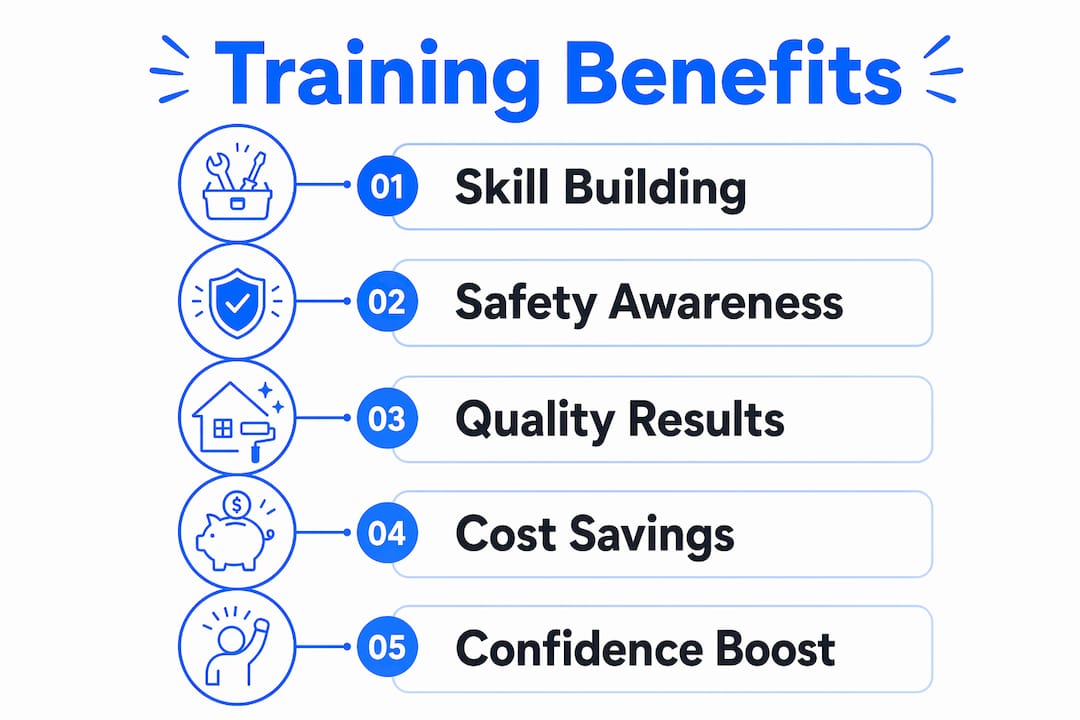
The most damaging misconception in home improvement is that training only matters for large or complex projects. Small jobs go wrong for the same reasons large ones do: missing knowledge, skipped steps, and undetected conditions behind the walls. A fresh coat of paint over a moisture problem does not fix the moisture problem. It hides it until the damage is severe enough to require a full remediation.
Restoration training teaches contractors to detect hidden moisture, mold, and structural damage that standard remodeling training misses entirely. Certified restoration professionals follow specific protocols to identify and remediate these conditions before renovation begins. A contractor without that training will tile over a wet subfloor and hand you a beautiful bathroom that develops black mold within 18 months.
The table below shows the practical difference between cosmetic work and restoration-informed remodeling:
Approach | What gets checked | Risk level |
Cosmetic remodeling only | Surface finishes, visible fixtures | High. Hidden damage goes undetected. |
Restoration-trained remodeling | Moisture levels, mold, structural integrity | Low. Issues are found and fixed before finishing. |
DIY without training | Whatever is visible | Very high. Critical conditions are routinely missed. |
Proper task sequencing and documentation are also learned skills, not instincts. Photographing and cataloging hidden conditions before closing walls protects homeowners from undiagnosed issues and supports insurance claims when damage appears later. A contractor who skips documentation is not saving time. They are transferring risk onto you.
Pro Tip: Before any renovation that opens walls or floors, ask your contractor to photograph existing conditions and provide you with a copy. This takes 20 minutes and can save thousands in disputed repairs later.
Why ongoing education and mentorship improve workforce retention
Training is not a one-time event. The construction and home improvement industries change constantly, with new materials, updated codes, and evolving best practices requiring continuous learning. Training programs that include career development reduce safety incidents, improve task sequencing, boost productivity, and increase retention. That return on investment is measurable in reduced turnover costs, fewer project delays, and lower insurance claims.
Mentorship accelerates the transfer of institutional knowledge in ways that classroom training cannot replicate. A senior carpenter who mentors a newer crew member passes on judgment calls, site-specific problem solving, and professional habits that take years to develop independently. That knowledge transfer keeps project quality consistent even as teams grow or change.
The Lowe’s Foundation $250 million commitment to train 250,000 skilled trade workers reflects an industry-wide recognition that the workforce pipeline is broken without structured investment. The program expanded five-fold after meeting its initial 50,000 trainee goal ahead of schedule. That result proves that demand for skilled trade training is real and that well-designed programs produce results at scale.
For home improvement businesses, the ROI of ongoing education shows up in several concrete ways:
Reduced turnover: Workers who see a clear training and advancement path stay longer, cutting the cost of recruiting and onboarding replacements.
Consistent project quality: Crews trained to the same standards produce predictable results, which protects reputation and reduces rework.
Leadership development: Leadership and technical training combined help retain crews and keep renovation projects on track and profitable.
Digital tracking tools: Software platforms that log training completion, certifications, and skill assessments give managers visibility into workforce readiness before assigning complex jobs.
Career path clarity: Workers who understand how training connects to advancement are more motivated and more likely to invest in their own development.
Manycolorswi builds this model into its workforce from day one. The company’s approach to home repair career development treats training as the foundation of every employee’s path, not an optional add-on.
Key takeaways
Training in home improvement is the single most reliable predictor of project safety, quality, and long-term value for both homeowners and contractors.
Point | Details |
Formal training raises project standards | Certified contractors deliver fewer delays, fewer code violations, and safer sites on every job. |
Homeowner workshops reduce costs | Community college DIY courses teach foundational skills that cut dependence on contractors for minor repairs. |
Restoration knowledge prevents hidden damage | Trained contractors detect moisture, mold, and structural issues before they become expensive surprises. |
Ongoing education improves retention | Continuous training and mentorship reduce turnover and keep project quality consistent across crews. |
Documentation protects homeowners | Photographing conditions before closing walls supports insurance claims and prevents disputed repairs. |
Why training is the investment most renovation budgets ignore
I have been in facilities management and home improvement long enough to watch the same pattern repeat. A homeowner hires the lowest bid, the contractor skips steps they were never trained to take, and six months later the call comes in about water damage, cracked tile, or a wall that should not have been touched. The money saved on the front end disappears twice over on the fix.
What surprises most people is that the gap between a trained and untrained contractor is not always visible in the finished work. A painted wall looks the same whether or not the contractor checked for moisture behind it. The difference shows up 18 months later, and by then the original contractor is long gone. That is the hidden cost of skipping the importance of training in renovations.
I have also watched what happens when homeowners take even a single workshop on basic repairs. They stop being passive participants in their own projects. They ask better questions, catch problems earlier, and make smarter decisions about when to call a professional. That shift in confidence changes the entire dynamic of a renovation.
The workers at Manycolorswi come from backgrounds where formal opportunity was scarce. Training is not a perk for them. It is the mechanism by which they build real careers and deliver real results. When I see a crew member who started with no construction experience complete a flooring or drywall project to a professional standard, that is the clearest proof I have that the benefits of education in home improvement extend far beyond the project itself. They build people, not just rooms.
— Ricco
Work with a team that trains to deliver
Manycolorswi brings trained, skilled contractors to every residential and commercial project in Milwaukee. Every crew member goes through structured skills development covering flooring, drywall, painting, and lawn care, with a focus on safety compliance and quality that holds up long after the job is done.

The company was built on the belief that training transforms outcomes, for the people doing the work and for the homeowners who live with the results. If you want a team that treats your home with the same care they put into their own professional development, explore Manycolorswi’s services and request a free consultation today. Every project starts with the right skills behind it.
FAQ
What is the role of training in home improvement?
Training in home improvement is the structured process of acquiring the skills, safety knowledge, and technical understanding needed to complete renovation and repair projects correctly. It applies to both professional contractors and homeowners managing their own repairs.
How does training affect the quality of a renovation?
Trained contractors deliver safer sites, fewer code violations, and higher quality finishes because they understand current building standards and proper task sequencing. Projects completed by certified professionals also carry fewer hidden risks like undetected moisture or structural damage.
What training workshops are available for homeowners?
Community colleges and local non-profit organizations offer low-cost or free DIY workshops covering basic plumbing, electrical work, carpentry, and tool safety. These courses are designed for adults with no prior experience and typically require only basic safety gear like steel-capped footwear.
Why does restoration training matter for remodeling projects?
Restoration-trained contractors can detect hidden moisture, mold, and structural damage before renovation begins, preventing costly surprises after walls are closed. Standard remodeling training does not cover these diagnostic protocols, which is why restoration experience is a meaningful differentiator.
How does ongoing training improve contractor retention?
Continuous training programs that include career development reduce turnover by giving workers a clear advancement path and building professional confidence. Lower turnover means more consistent project quality and lower costs for home improvement businesses and their clients.
Recommended
Comments