
What Does Home Repair Timeline Mean for Homeowners

Most homeowners hear “home repair timeline” and picture a list of tasks with dates next to them. That’s part of it. But understanding what does home repair timeline mean at a deeper level reveals something far more useful: a planning system that covers scheduling, budgeting, risk management, and damage prevention all at once. When you treat a repair timeline as just a to-do list, you leave yourself open to costly surprises, unnecessary delays, and repairs that snowball into major expenses. This article breaks down exactly what a home repair timeline includes, how long different phases take, and how to build one that actually works for you.
Table of Contents
Key takeaways
Point | Details |
More than a schedule | A home repair timeline covers budgeting, permits, sequencing, and risk, not just dates. |
Phases add up fast | Planning, permitting, and contractor scheduling can consume months before work even starts. |
Proactive beats reactive | Scheduled maintenance costs far less than emergency repairs, which can double total costs. |
Buffer time is non-negotiable | Most projects run 10 to 20 percent over estimates, so build padding into every phase. |
Seasonal timing saves money | Aligning tasks with the right season reduces costs and prevents preventable damage. |
What does home repair timeline mean, exactly
A home repair timeline is not a checklist. It’s a structured plan that maps out every phase of a repair or renovation project from the moment you identify a problem to the final walkthrough after the work is complete.
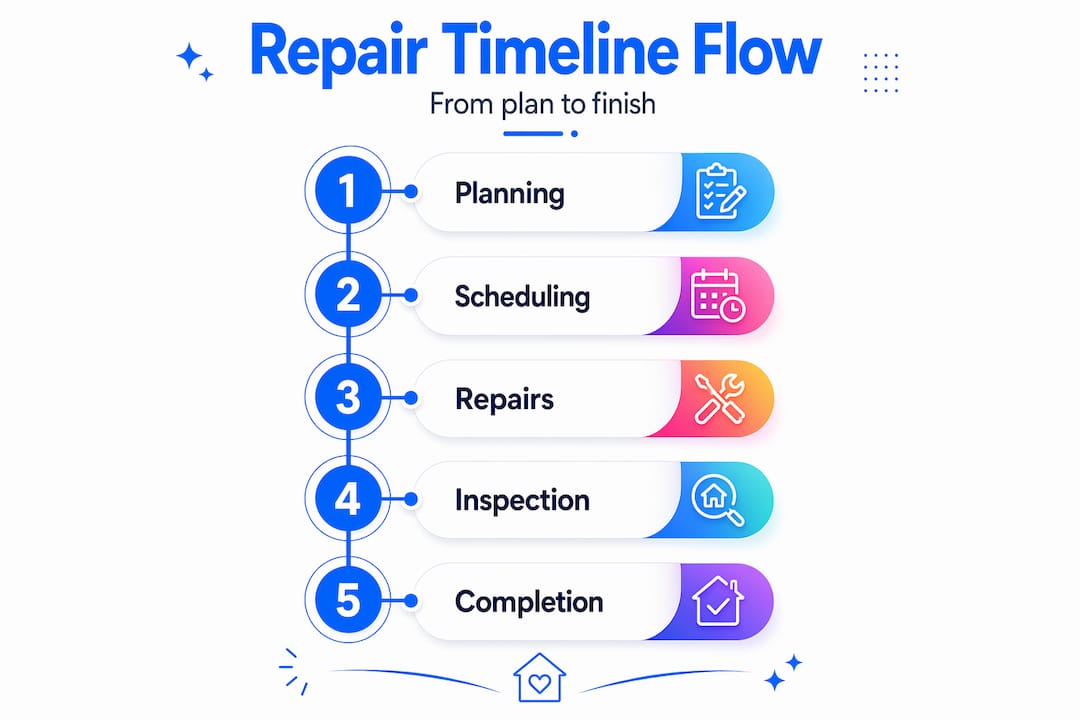
Think of it in layers. The first layer is the planning phase, where you assess what needs to be done, get estimates, and decide on scope. The second layer is scheduling, which includes booking contractors, ordering materials, and pulling permits. The third layer is the execution phase, the actual repair work. The fourth layer is inspection and closeout, where work gets verified and approved.
Here’s where the repair timeline explained in full form starts to surprise most homeowners. The actual construction or repair work is often the shortest phase. What makes timelines stretch are the steps surrounding that work. Comprehensive renovations can run from 10 to 24 months in total, with planning and design alone taking 2 to 6 months and permits adding another 1 to 6 months before a single nail gets driven.
A well-built timeline also distinguishes between three types of activity:
Preventive maintenance tasks you schedule ahead of time to keep systems running, like annual HVAC tune-ups or seasonal gutter cleaning
Reactive repairs that happen after something breaks, which are harder to control but can still be planned for through contingency budgeting
Renovation-related timelines that follow a project arc from concept to completion, involving design decisions, permits, sequencing, and inspections
Understanding home repair through this three-category lens changes how you plan. You stop reacting to problems and start anticipating them. Sequencing also matters. Doing drywall before addressing a plumbing leak behind the wall, for example, creates rework and added cost. A proper timeline accounts for the order in which tasks must happen to avoid that kind of waste.
How long home repairs actually take
Setting realistic expectations on the repair time frame is where most homeowners get caught off guard. They think the work takes as long as the contractor is physically on site. That’s rarely accurate.
Here is a breakdown of typical durations for common repair and renovation phases:
Phase | Typical Duration | What affects timing |
Planning and estimates | 1 to 4 weeks | Scope complexity, number of contractors consulted |
Permitting and approvals | 1 to 6 months | Local municipality, project type |
Contractor scheduling | 2 to 4 weeks | Seasonal demand, contractor availability |
Actual repair or build work | Days to several months | Project scale, crew size, material availability |
Inspections and closeout | 1 to 3 weeks | Inspector availability, any required corrections |
The number that shocks most people is contractor lead time. Scheduling alone can add 2 to 4 weeks before any work begins, even for short jobs, due to high demand in today’s market. That means a bathroom repair you expected to finish in two weeks can easily stretch to six once you account for booking, materials, and inspection.

Unforeseen complications are the other major timeline disruptor. Opening a wall and finding mold, water damage, or outdated wiring turns a one-day fix into a multi-phase project. The home renovation timeline needs to account for that possibility, not just the ideal-case scenario.
Pro Tip: Build a 2 to 4 week buffer into every phase of your repair plan. Most projects run 10 to 20 percent over original estimates due to unforeseen complications.
Smaller projects like painting a room or replacing flooring in a single space can be completed in a few days once materials are on hand and a crew is available. Whole-home repairs or full renovations sit at the opposite end of the spectrum and can span well over a year. The home maintenance schedule sits somewhere in the middle: recurring tasks that are short in duration but require consistent scheduling throughout the year.
The real cost of skipping your repair timeline
Here’s the financial reality most homeowners learn the hard way: reactive repairs cost significantly more than planned ones. Emergency repairs can double total costs compared to scheduled maintenance, because out-of-hours labor and rush-order parts don’t come cheap.
The concept of Repair Turnaround Time, often called RTAT, captures this well. RTAT measures the time between when a system fails and when it’s restored to working condition. Proactive maintenance keeps RTAT near zero because you address issues before failure occurs. Reactive repairs, on the other hand, can cause extended downtime while you scramble for contractors, parts, and approvals.
A few overlooked examples that escalate quickly:
Skipping annual HVAC maintenance leads to mid-summer compressor failure, which often requires replacement rather than repair. The $5,000 Rule for HVAC shows that when a system’s age multiplied by repair cost exceeds that threshold, replacement becomes the smarter financial move.
Ignoring a small roof leak for one season allows water intrusion to damage insulation, decking, and interior ceilings, turning a $400 flashing repair into a $6,000 project.
Putting off caulking around tubs and windows lets moisture work into framing and drywall, which leads to mold remediation costs that far exceed the original maintenance task.
“Home repair timelines are best understood as risk management tools that transform emergency costs into manageable planned expenses.”
Neglecting even a 30-minute maintenance task can shift a future repair from a manageable few hours to several days of work with dramatically higher costs. The home repair schedule isn’t just about staying organized. It’s about protecting your financial investment in the property.
How to build your own repair timeline
Creating a personalized repair timeline doesn’t require professional software or a contractor’s license. It requires honest assessment and consistent follow-through. Here’s how to approach it:
Assess your home’s age and condition. Older homes have predictable failure points. A 20-year-old roof, a furnace past 15 years, or galvanized pipes all belong on your radar before they become emergencies. Routine inspections prevent small issues from becoming costly repairs and extend the lifespan of your home’s systems.
Prioritize by impact. Safety and structural integrity come first. Then water-related systems, which cause the most damage when they fail silently. Cosmetic repairs come last.
Account for local permit realities. Talk to your local building department before you finalize any timeline. Permit timelines vary widely by municipality and project type, and ignoring this step has derailed more than a few renovation schedules.
Align tasks with seasons. Seasonal maintenance scheduling saves money and prevents damage. HVAC servicing before summer heat, gutter cleaning before fall rains, and weatherstripping before winter all follow natural timing logic.
Use a home maintenance checklist as your baseline. Starting from a room-by-room or system-by-system checklist gives you a repeatable structure instead of guessing what to include each year.
Pro Tip: Don’t schedule every repair back to back. Give yourself a week between phases to handle surprise findings, material delays, or contractor schedule shifts without derailing the entire project.
Here’s a quick comparison of how planned versus unplanned approaches differ in practice:
Approach | Timeline control | Cost predictability | Stress level |
Planned repair schedule | High | High | Low |
Reactive repairs only | Low | Low | High |
Mixed (some planning) | Medium | Medium | Medium |
The message is clear. A well-sequenced project plan delivers better outcomes at every level, from finances to day-to-day stress.
My take on what most homeowners get wrong
I’ve been working in facilities management and home improvement for years, and the pattern I see most often is this: homeowners treat their repair timeline like a suggestion, not a system. They know the furnace needs servicing. They know the deck is showing wear. But they push it to next month, and next month becomes next year.
What I’ve learned is that the timeline isn’t about perfectionism. It’s about understanding which delays cost you money and which ones are genuinely fine to postpone. A fresh coat of interior paint can wait. A slow drain that backs up into a finished basement cannot.
The projects I’ve seen go sideways the fastest are the ones where the homeowner skipped the planning phase entirely and called a contractor expecting work to start the following week. They didn’t account for permits, didn’t order materials in advance, and had no buffer when the contractor found water damage behind the drywall. What should have been a two-week kitchen refresh turned into two months of chaos.
My honest advice: treat your home like a commercial property. Facility managers don’t wait for systems to fail. They run inspection schedules, track system ages, and plan replacements before they become emergencies. That mindset, applied at the residential level, is what a real home repair timeline looks like. You don’t need expensive software. You need a calendar, a list, and the discipline to follow through.
— Ricco
Let Manycolorswi take the guesswork out of your timeline
Planning a home repair or renovation project is easier when you have professionals in your corner who understand both the work and the scheduling realities behind it.

Manycolorswi offers hands-on home repair and improvement services in Milwaukee, covering everything from flooring and drywall to painting and lawn care. Whether you’re managing a multi-phase renovation or tackling a high-impact interior repair before putting your home on the market, the team at Manycolorswi brings both the skills and the scheduling know-how to keep your project on track. Visit Many Colors Home Improvement to learn more about available services and how they can help you plan and execute your next project with confidence.
FAQ
What does a home repair timeline include?
A home repair timeline includes planning, permitting, contractor scheduling, material lead times, actual repair work, and final inspection. It covers every phase from identifying the problem to confirming the work is complete.
How long does a typical home renovation take?
Home renovations range from 10 to 24 months for whole-home projects, while smaller repairs can be completed in days or a few weeks depending on scope and scheduling availability.
Why do home repairs take longer than expected?
Most delays come from contractor lead times, permit processing, and unforeseen complications discovered during the work. Building a 2 to 4 week buffer into each phase helps absorb those setbacks without derailing the full schedule.
What is the difference between a maintenance schedule and a repair timeline?
A maintenance schedule is a recurring plan for preventive tasks like HVAC servicing and gutter cleaning. A repair timeline is a project-specific plan for addressing damage or making improvements, often with a defined start and end date.
How can I reduce emergency repair costs at home?
Following a consistent home maintenance schedule is the most effective way to reduce emergency repair costs. Addressing small issues before they escalate prevents the labor premiums and rush costs that come with reactive fixes.
Recommended
Comments