
Social Enterprise Home Improvement Explained for Communities

A social enterprise in home improvement is defined as a business that integrates a social or environmental mission directly into its trade operations, reinvesting profits to empower communities rather than distributing them to shareholders. This model sits at the intersection of nonprofit purpose and commercial discipline, making social enterprise home improvement explained not just a concept but a working reality in cities like Milwaukee, Philadelphia, and Zurich. Organizations like Manycolorswi, IKEA Switzerland, and Philadelphia’s FiXA connector demonstrate that mission-driven business models can deliver flooring, drywall, painting, and renovation work at commercial-grade quality while simultaneously creating jobs for people who are typically overlooked by the traditional labor market.
What social enterprise home improvement explained really means
Social enterprises combine a social mission with sustainable business models, reinvesting surplus to achieve social and environmental impact. That definition matters because it rules out two common misconceptions: that these businesses are charities dependent on donations, and that they sacrifice quality for goodwill. The social mission is built into the operating model, not bolted on as a marketing afterthought.
In the home improvement sector, this means a company like Manycolorswi hires and trains residents from homeless shelters in Milwaukee, teaches them flooring installation, drywall repair, painting, and lawn care, and then deploys them on real residential and commercial projects. The revenue from those projects funds more training, more hiring, and more community impact. The business sustains itself through trade income, not grants alone.

Understanding social enterprises in this context requires recognizing that the workforce model is the product. Clients receive a repaired home. Workers receive skills, income, and a path back into the labor market. Both outcomes are deliberate, measurable, and interdependent.
How do social enterprises work in home improvement?
The operational model of a home improvement social enterprise differs from a traditional contractor in three structural ways: workforce composition, profit reinvestment, and quality assurance design.
Workforce composition is the most visible difference. Rather than hiring only experienced tradespeople, these organizations recruit from marginalized populations, including formerly homeless individuals, people with disabilities, and long-term unemployed workers. IKEA Switzerland contracts social enterprises BAND and VEBO to deliver kitchen installation services, pairing a licensed supervisor with an employee with a disability on every visit. The result is commercial-grade service with inclusive employment built into the delivery structure.
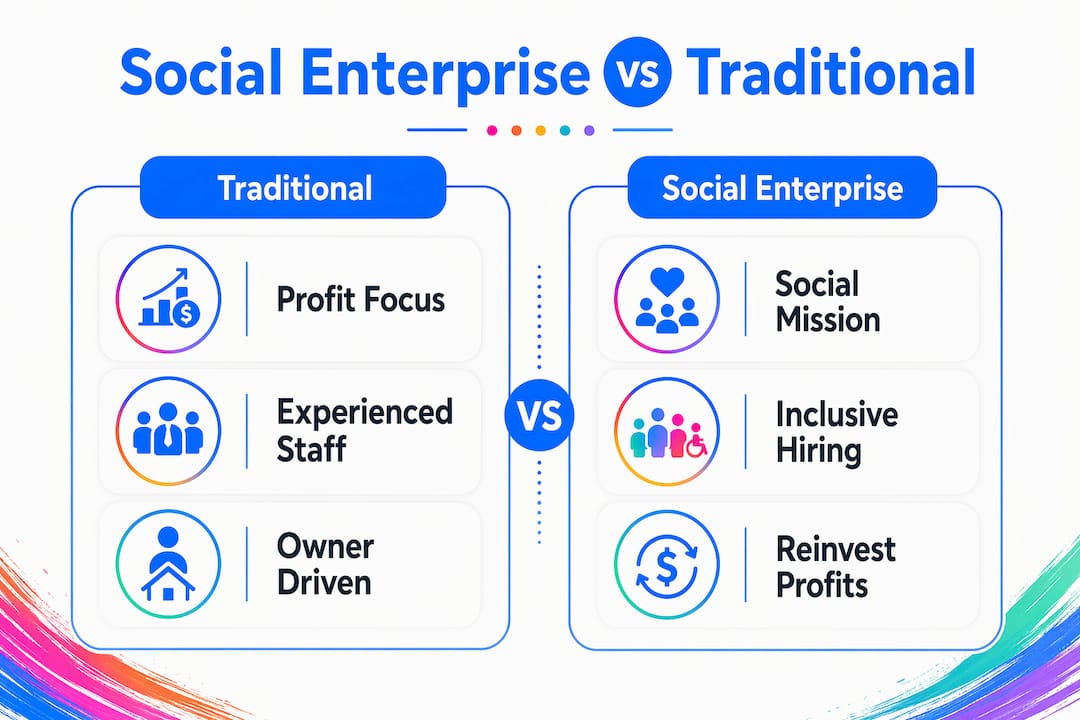
Profit reinvestment replaces shareholder returns. Revenue generated from home repair contracts flows back into training programs, equipment, and organizational capacity. This is what separates a social enterprise from a standard small business with charitable intentions. Financial viability and social impact are treated as interdependent, not competing priorities.
Quality assurance is designed as a standard process, not an exception. Supervision is embedded into every job, not added when problems arise. This matters because clients choosing a social enterprise contractor are not accepting lower standards in exchange for a good cause. They are receiving a service where quality control is structurally enforced.
Workforce teams include trained supervisors on every project
Licensing and insurance verification are non-negotiable prerequisites
Customer workflows mirror those of traditional contractors: estimates, scheduling, completion checks
Feedback loops from clients inform ongoing training improvements
Pro Tip: When evaluating a social enterprise home improvement contractor, ask specifically how supervision is structured on job sites. A well-run organization will describe a clear supervisor-to-worker ratio and a defined quality verification process, not a general commitment to doing good work.
Social enterprise vs. traditional home improvement business
The differences between a social enterprise and a traditional home improvement business go beyond mission statements. They affect governance, funding, hiring, and how success is measured.
Point | Traditional business | Social enterprise |
Primary goal | Profit maximization for owners | Social and environmental mission with financial sustainability |
Revenue sources | Client fees, contracts | Client fees, grants, social investment |
Workforce model | Hire for experience and efficiency | Hire for inclusion, train for competence |
Profit use | Distributed to owners or reinvested for growth | Reinvested into social mission and community programs |
Success metrics | Revenue, margin, market share | Employment outcomes, community impact, financial viability |
Governance | Owner or shareholder accountability | Accountability to stakeholders, community, and mission |
The governance distinction is particularly significant. A traditional contractor answers to its owners. A social enterprise answers to its mission, its workforce, and the community it serves. That accountability structure shapes every decision, from which neighborhoods to prioritize to how training budgets are allocated.
Traditional businesses can adopt socially responsible practices, but those practices remain optional and reversible. In a social enterprise, the mission is the legal and operational foundation. Removing it would change what the organization fundamentally is. This is why community-driven home projects delivered by social enterprises tend to produce more consistent community outcomes than corporate social responsibility programs run by conventional contractors.
What impact do home improvement social enterprises actually create?
The social and environmental outcomes of home improvement social enterprises fall into two distinct categories: employment and training outcomes, and property and environmental outcomes. Separating these two tracks is critical to measuring and reporting credible impact.
On the employment side, organizations like Manycolorswi create jobs for people who face the highest barriers to workforce entry. Formerly homeless individuals gain certified trade skills, consistent income, and professional references. These are not temporary placements. They are career entry points. The SEDI program in Australia provides grants up to A$120,000 specifically to help social enterprises build the capacity to deliver these outcomes at scale, covering business planning, financial management, and outcomes measurement. That level of public investment reflects how seriously governments are beginning to treat social enterprise workforce development.
On the environmental side, sustainable home refurbishment by social enterprises contributes directly to reducing energy poverty and greenhouse gas emissions, particularly for vulnerable households that cannot afford conventional renovation costs. Energy-efficient upgrades, including insulation, window replacement, and efficient heating systems, lower utility bills for low-income homeowners while reducing carbon output. The social and environmental benefits reinforce each other.
Pro Tip: If you are commissioning a home improvement social enterprise for a renovation project, request a simple impact report after completion. Reputable organizations track employment hours, training milestones, and property outcomes separately, giving you concrete data on the social value your project generated.
Impact measurement frameworks used by leading organizations separate property outcomes from employment outcomes and link both to trackable measures. The SEDI program treats evaluation as a core capability, not an afterthought. Social Return on Investment (SROI) analysis is increasingly used to quantify the broader value created per dollar spent, often revealing that social enterprise projects generate two to four times their direct cost in community value.
How to start and scale a social enterprise in home improvement
Building a home improvement social enterprise requires more than a compelling mission. It demands operational infrastructure, financial planning, and a systematic approach to quality and growth. Here is how organizations with proven track records approach it.
Define the social mission with precision. Vague commitments to “helping communities” do not hold up under operational pressure. Specify which population you serve, what outcomes you are targeting, and how you will measure them. Manycolorswi focuses specifically on residents of homeless shelters in Milwaukee, which makes hiring, training, and impact reporting concrete and verifiable.
Build the business fundamentals first. Licensing, insurance, customer intake workflows, and pricing structures must be in place before the first job. The FiXA home repair connector in Philadelphia demonstrates that contractor vetting through interviews, reference checks, and license verification is non-negotiable for maintaining service quality and client trust.
Pursue public and social investment funding. Grants like Australia’s SEDI program provide up to A$120,000 for capability building, covering financial management, contract negotiation, and outcomes tracking. In the United States, community development financial institutions (CDFIs) and local government workforce programs offer comparable support. Funding should build operational capacity, not substitute for trading income.
Design supervision as a system, not a role. Quality assurance in inclusive workforce models requires that supervision is a standard process embedded in every job. The IKEA Switzerland pilot, which pairs a licensed supervisor with an employee with a disability on every installation visit, proves that inclusive employment and commercial service standards are fully compatible when supervision is structural.
Pilot, measure, and iterate. Start with a defined service area and a manageable number of projects. Collect data on both property outcomes and employment outcomes from the first job. Use that data to refine training, adjust pricing, and demonstrate impact to funders and clients. Scaling before the model is proven creates operational debt that is difficult to recover from.
Invest in technology for scheduling and client management. Automation in home services reduces administrative overhead, freeing leadership to focus on workforce development and mission delivery rather than manual scheduling and invoicing.
Key takeaways
Social enterprise home improvement works because it treats workforce inclusion and commercial service quality as mutually reinforcing, not competing, priorities.
Point | Details |
Core definition | Social enterprises reinvest profits into social missions rather than distributing them to owners. |
Operational model | Inclusive workforce teams with embedded supervision deliver commercial-grade home improvement services. |
Impact measurement | Separate employment outcomes from property outcomes to report credible, trackable social value. |
Funding pathways | Grants like SEDI and CDFIs build operational capacity without replacing trading income. |
Scaling requirement | Licensing, vetting systems, and quality assurance infrastructure must precede growth. |
Why this model is the future of home improvement, not a niche experiment
I have spent years working in facilities management and home improvement, and the most persistent myth I encounter is that hiring people with barriers to employment means accepting lower quality. That belief is wrong, and the evidence from organizations like IKEA Switzerland and Manycolorswi proves it.
What I have found is that workers who are given a genuine second chance bring a level of commitment that experienced tradespeople hired off a job board often do not. When someone has been living in a shelter and is handed real tools, real training, and a real paycheck, they show up. They pay attention. They want to get it right. The challenge is not motivation. The challenge is building the operational systems that support them: clear supervision, structured training, and consistent quality checks.
The social enterprise model forces you to build those systems because your mission depends on them. A traditional contractor can cut corners on supervision and still make money. A social enterprise cannot, because the workforce development outcomes collapse without structure. That constraint turns out to be a competitive advantage.
I also believe the environmental dimension of this work is underappreciated. When Manycolorswi completes an energy-efficient renovation for a low-income homeowner in Milwaukee, that project reduces utility costs, improves living conditions, and creates a skilled worker who can do the same for the next household. The compounding effect of that work across a neighborhood is real and measurable. The home improvement industry has an opportunity to lead on both workforce equity and environmental sustainability. Social enterprises are not waiting for the industry to catch up. They are already doing the work.
— Ricco
How Manycolorswi puts this model into practice

Manycolorswi was built on exactly the principles this article describes. Founded to address the specific challenges faced by residents of a homeless shelter in Milwaukee, the company provides flooring, drywall, painting, and lawn care services while training and employing people who are typically excluded from the workforce. Led by Ricco, an experienced facilities director, Manycolorswi promotes diversity, teamwork, and dignity across every project it takes on. If you are looking for home repair with social impact or want to partner with a company whose work creates measurable community value, visit Manycolorswi to learn more about available services and how to get involved.
FAQ
What is a social enterprise in home improvement?
A social enterprise in home improvement is a business that delivers trade services like flooring, painting, and renovation while reinvesting profits into a social mission such as workforce training for marginalized groups. The mission is built into the operating model, not added as a marketing layer.
How do social enterprises fund their operations?
Social enterprises primarily generate revenue through client contracts and service fees, supplemented by grants and social investment programs. Australia’s SEDI program, for example, provides grants up to A$120,000 for capability building, but trading income remains the foundation of financial sustainability.
Are social enterprise home improvement companies as reliable as traditional contractors?
Yes. Organizations like IKEA Switzerland’s supply chain partners BAND and VEBO demonstrate that inclusive workforce models with embedded supervision deliver commercial-grade service quality. Reliability depends on operational systems, not workforce background.
What social and environmental benefits do these enterprises create?
They create direct employment for vulnerable populations, provide trade skills training, and deliver energy-efficient home renovations that reduce energy poverty and greenhouse gas emissions for low-income households.
How can I find or support a social enterprise home improvement company?
Search for mission-led home repair companies in your area, ask contractors directly about their hiring practices and profit reinvestment policies, or engage organizations like Manycolorswi that publicly document their social mission and workforce outcomes.
Recommended
Comments