
Why Mission-Led Companies Prioritize Homeowners

There’s a striking contradiction at the heart of American homeownership. 84% of homeowners report anxiety related to owning their home, yet 97% still say it’s worth it. That gap between stress and commitment is exactly where mission-led companies operate. Understanding why mission-led companies prioritize homeowners isn’t just a feel-good story. It’s a business case, a community strategy, and a trust-building framework that benefits everyone involved.
Table of Contents
Key takeaways
Point | Details |
Mission drives prioritization | Mission-led companies center homeowners because their success depends on community trust, not just transactions. |
Homeowners are high-stakes stakeholders | With homes as their largest single asset, homeowners need partners who treat that investment with care. |
Mission and profit coexist | Companies like Sunrise Banks prove that mission-driven growth scales financially without sacrificing social impact. |
Structural mission beats promises | Embedding values into governance and operations prevents mission drift and keeps homeowner focus consistent over time. |
Community impact raises property value | Active local involvement and mission-aligned services protect and grow what homeowners care about most. |
Why mission-led companies prioritize homeowners
The term “mission-driven” gets used loosely. A company slaps a purpose statement on its website and calls it a mission. That’s not what we’re talking about here. True mission-driven businesses make decisions differently. They ask not just “Is this profitable?” but “Does this serve the people and communities we exist for?”
In the home improvement and services space, that distinction matters enormously. Here’s what actually separates mission-led companies from the rest:
Values embedded in operations. Mission-led companies don’t treat social impact as a marketing line item. They build it into hiring, pricing, and service delivery from day one.
Employee engagement as a driver. Mission-driven companies attract employees who are genuinely invested in outcomes, which translates directly into better work quality and authentic community relationships.
Faster growth through community. Purpose-driven startups grow 3x faster because they build movements around shared values, not just customer bases. Word-of-mouth from a homeowner who genuinely trusts you is worth more than any paid ad.
Transparency as a baseline expectation. Consumer expectations now treat authentic mission behavior as a minimum standard, especially among younger homeowners. Authenticity isn’t optional anymore.
The contrast with traditional profit-focused firms is real. A conventional home services company optimizes for margin per job. A mission-led company optimizes for the relationship, the neighborhood, and the long-term outcome. That’s not idealism. It’s a different business model with a different definition of success.
Pro Tip: If you’re evaluating whether a company is genuinely mission-led, ask how their mission shows up in their hiring decisions. If they can’t answer that concretely, the mission lives only on paper.
Homeowners as the core strategic priority
Homeownership in America is deeply personal. 49% of homeowners identify their home as their single most valuable financial asset. That’s not just a statistic. It means that when a contractor shows up at someone’s door, they’re entering the most financially and emotionally significant space in that person’s life.
Mission-focused firms understand this weight. Here’s why homeowners become the strategic center of their work:
Anxiety creates demand for trust. When 84% of homeowners feel stressed about their property, they’re not looking for the cheapest bid. They’re looking for someone they can believe in. Mission-led companies earn that trust structurally, not just through good marketing.
The neighbors-helping-neighbors philosophy. This isn’t a slogan. It’s an operating principle. When a company hires from the local community, trains people who live nearby, and reinvests in the neighborhood, homeowners feel that difference. The work becomes personal on both sides.
Proactive engagement reduces anxiety. Mission-led companies don’t wait for problems to escalate. They communicate early, explain their process clearly, and treat homeowners as partners rather than job sites.
Community investment compounds over time. Mira Home has directed over $2.5 million toward charitable causes, embedding social impact directly into its home service model. That level of commitment signals to homeowners that the company’s values are real and sustained.
The values of mission-led organizations align naturally with what homeowners need most: reliability, honesty, and a genuine stake in the outcome. That alignment isn’t accidental. It’s strategic.
Mission-led vs. traditional home service companies

The difference between a mission-led home improvement company and a conventional one isn’t just about charity. It’s structural. It shows up in how they price work, who they hire, and what they do when a job gets complicated.
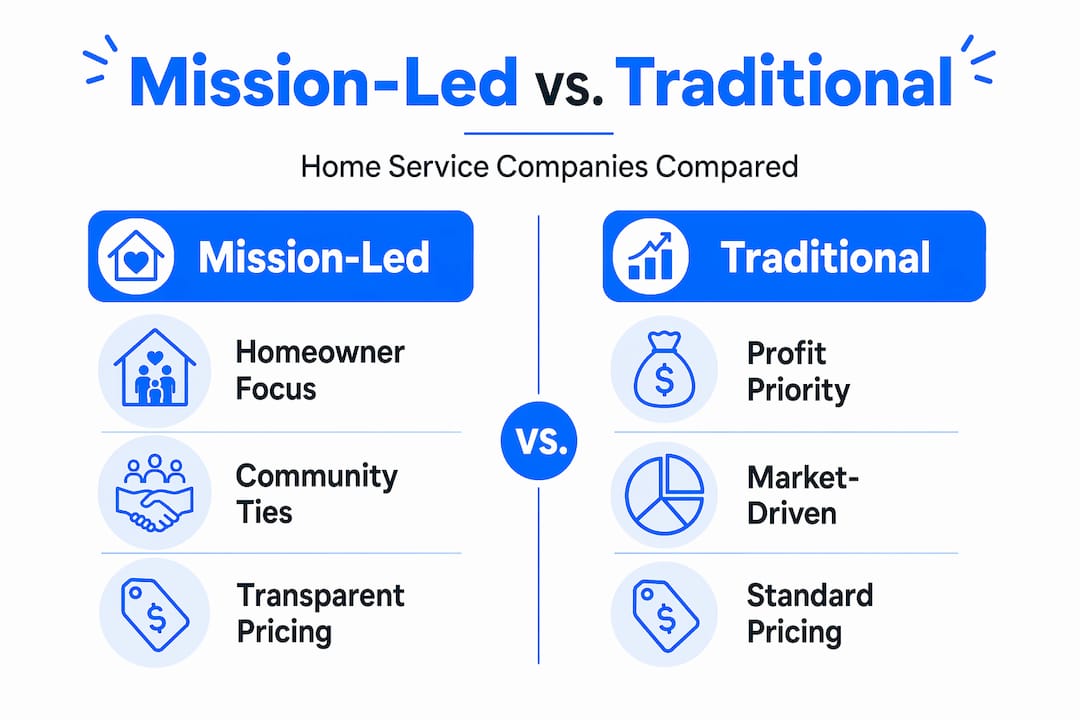
Aspect | Mission-led companies | Traditional companies |
Pricing philosophy | Social and ecological costs integrated into pricing decisions | Margin-first pricing with minimal external consideration |
Hiring practices | Prioritize underserved workers, train from within | Hire for speed and lowest labor cost |
Community involvement | Active local engagement, neighborhood investment | Transactional; limited community presence |
Mission protection | Embedded in governance structures to prevent drift | Dependent on individual leadership decisions |
Homeowner relationship | Long-term partnership, proactive communication | Project-based, reactive communication |
That governance point deserves more attention. A mission-led company that protects its values only through a founder’s personal commitment is one leadership change away from abandoning everything. The strongest mission-driven businesses embed their values into legal and operational structures. That’s what makes the homeowner prioritization durable, not just aspirational.
Community oversight and local involvement also protect property values in ways that proximity to commercial centers simply cannot. Buyers prioritize neighborhoods with active maintenance systems and community accountability. Mission-led home service companies contribute directly to that ecosystem.
Pro Tip: When choosing a home improvement partner, look for companies that can show you their community involvement, not just describe it. Ask for specific examples: who they hired, what neighborhoods they worked in, what they gave back.
How mission-focused firms help homeowners build wealth
The benefits of mission-led companies for homeowners go well beyond a good experience on a single project. They connect to long-term financial stability in concrete ways.
Energy-efficient home improvements reduce utility bills over 7 to 10 years in ways that enable homeowners to refinance strategically and reinvest in further upgrades. Mission-led companies that prioritize these improvements aren’t just doing good work. They’re creating permanent financial advantages for the families they serve.
Consider what this looks like in practice:
A mission-led contractor installs energy-efficient insulation and windows, reducing a homeowner’s monthly utility costs by $150. Over 10 years, that’s $18,000 in savings that can fund a kitchen renovation or reduce mortgage debt.
A company committed to cause-aligned home renovation brings higher customer retention because homeowners come back for every project, not just the first one. That loyalty creates neighborhood-wide referral networks.
Mission-driven lending models, like those pioneered by Sunrise Banks, demonstrate that directing resources toward underserved communities produces extraordinary returns. Assets grew from $14 million to $2.4 billion by focusing over 60% of loans on low-to-moderate income communities.
The importance of homeowners in this equation cannot be overstated. Homeowners who partner with mission-led companies don’t just get better work done. They participate in a model that strengthens their neighborhood, supports local workers, and builds equity at multiple levels simultaneously.
Supporting homeowners in business missions also means making quality home improvement accessible, not just aspirational. When a company trains and employs workers from marginalized backgrounds, it reduces labor costs tied to high turnover, which often translates into more competitive pricing without sacrificing quality. Explore home improvement with community impact to see how this model operates in practice.
My perspective: mission is the competitive advantage nobody talks about
I’ve spent years working in facilities management and home improvement, and the conversation I hear most often from business leaders goes something like this: “We want to do good, but we can’t afford to sacrifice margin.” That framing is the problem.
In my experience, the scarcity mindset that treats mission and profit as opposites is exactly what holds companies back. The most resilient businesses I’ve seen operate from abundance. They believe that investing in people, including their workers and their customers, creates more value than it costs. Every time.
What I’ve learned about homeowner trust is this: it’s not earned through a polished pitch or a professional logo. It’s earned through consistency, transparency, and genuine investment in outcomes beyond the invoice. When a homeowner sees that your crew includes people from their community who were given a real opportunity, something shifts. They stop seeing a contractor and start seeing a neighbor.
The companies that will matter in this industry over the next decade aren’t the ones with the best marketing. They’re the ones with the deepest roots. Mission isn’t a differentiator you bolt on after you’re profitable. It’s the foundation you build on from day one, and it compounds in ways that pure margin-chasing never does.
If you’re a business leader reading this, the question isn’t whether you can afford to prioritize homeowners through a mission-driven lens. The question is whether you can afford not to.
— Ricco
How Manycolorswi brings this mission to life

At Manycolorswi, the mission isn’t a statement on a wall. It’s the reason the company exists. Founded to address the real challenges faced by residents of a Milwaukee homeless shelter, Many Colors hires and trains individuals who are often overlooked, giving them skills, confidence, and a genuine path forward. Every flooring installation, drywall repair, painting job, and lawn care project carries that purpose with it.
For homeowners in Milwaukee and the surrounding area, choosing Many Colors means choosing a company where your home improvement project directly supports workforce reintegration and community rebuilding. The neighbors-helping-neighbors philosophy isn’t a tagline here. It’s the operating model. When you work with Many Colors, you’re not just getting quality home services. You’re investing in the kind of community where everyone has a fair shot.
FAQ
What makes a company truly mission-led?
A truly mission-led company embeds its values into hiring, pricing, governance, and daily operations rather than treating social impact as a separate initiative. Mission protection through legal and structural frameworks, not just leadership promises, is what separates genuine mission-driven businesses from those using purpose as a marketing tool.
Why do mission-driven businesses prioritize homeowners specifically?
Homeowners represent the highest-stakes stakeholders in the home services space, with their property often being their largest financial asset. Mission-led companies prioritize homeowners because building long-term community trust is both their ethical commitment and their most durable competitive advantage.
Do mission-led companies charge more for their services?
Not necessarily. Companies that integrate social costs into their operations and maintain lower employee turnover through genuine investment in their workforce often deliver competitive pricing. The mission-driven lending model at Sunrise Banks, for example, scaled to $2.4 billion in assets while serving underserved communities.
How can homeowners identify a genuinely mission-focused company?
Ask for specific examples of community involvement, workforce development programs, and how their mission shows up in hiring decisions. Genuine mission-driven businesses can answer these questions concretely and consistently, not just in general terms.
Does supporting mission-led companies actually improve property values?
Yes. Active community oversight and local involvement from mission-led companies protect and grow property values more reliably than proximity to commercial centers alone. Neighborhoods with strong community accountability systems attract buyers who prioritize long-term stability.
Recommended
Comments